
CTRL+ALT+ DISRUPT EDUCATION
An Entirely Opinionated Piece on Chromebooks in School

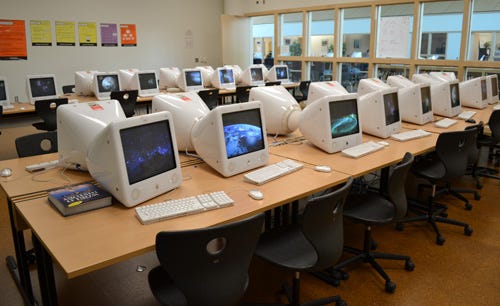
Remember showing up to class excited because the teacher booked the computer lab?
POV: It’s 2008 and you walk into class with your backpack and lunch box. It’s only 8:33 and you’ve already had a long morning because mom yelled at you for drinking Sprite for breakfast, and you’re having an anxiety attack hoping nobody remembers the fart from yesterday that was supposed to be silent. Something in your body is off—imbalanced. It could be growing pains or hormones, maybe. Whatever it is, you’re practically convinced you’ve hit rock bottom.
But then you walk into class and written on the chalkboard is the agenda:
12:00 LUNCH
12:35 COMPUTER LAB
Suddenly, your mood shifts—there are leprechauns and rainbows jumping from desk to desk.
Unfortunately, today’s students have never had that experience—the euphoria. They’ve never had to wait for it, earn it, or look forward to it. They also, however, have never had the experience of being able to read an analog clock.
It has come to my attention recently that a good majority of my middle school students do not know how to read analog clocks. They love to ask me the question, “How much time is left?” and I love to give them the answer, “There’s a schedule and a clock on the wall, so figure it out.” I thought I was teaching them to use their resources—until a couple of courageous students informed me that nobody knows how to read those clocks.
My mind was blown. I didn’t understand. “What do you mean?” I asked. And their answer was that they didn’t get taught.
Do I believe them? Most of them, yes.
And that realization leads to a bigger question: what else are they not learning—not because they can’t, but because the environment no longer requires it?
When given the opportunity to work in class, many students do not take it seriously. They would rather pull out their Chromebooks—even if they aren’t needed—and play whatever game it is on New Math. Sometimes, they aren’t even playing games; they’re checking their grades. That sounds productive, but more often than not, it’s just another way of avoiding the task in front of them.
These kids would rather do anything other than what they’re supposed to.
So is it laziness? Pure academic disengagement? Or is it something we’ve unintentionally trained?
Because when everything lives on a screen—answers, shortcuts, entertainment—it becomes easy to believe that learning happens just by being exposed to information. But osmosis isn’t the process of information entering your brain by simply staring at a screen. Learning requires effort. It requires attention.
And more and more, we are removing both.
Conversations—complete ones with tone, impression, and meaning—are becoming scarce for teenagers. We used to have to knock on someone’s front door and face their parents. There was practice in that. There was discomfort, and growth, and human interaction.
Now, there is less of it.
Less human interaction equals less humanity.
Our brains weren’t made for constant stimulation, yet that is exactly what students are getting all day, every day. There is always something to click, watch, scroll, or check. No pause. No quiet. No boredom.
But boredom matters.
Boredom is where thinking begins. It’s where creativity forms. Without it, students lose the ability to generate their own thoughts. So maybe the solution isn’t more engagement tools or more technology—maybe it’s less noise.
Students ask me questions about time all day. When I ask them about their ability to read a clock, they have no problem—no shame—admitting they don’t know how. And they definitely have no problem throwing elementary teachers under the bus for not teaching them.
But let’s stay on the topic of time.
Time management is something millions of people struggle with, regardless of age—hence the word procrastination. But when students are given time, how many of them can successfully work independently to create quality work?
That independence is a skill. And like any skill, it has to be practiced.
If your niche is education and you have either eyes or ears, then you know reading skills have been decreasing for at least the past six years. Reading and writing transfer directly to verbal communication, and we are watching that decline happen in real time.
I am a firm believer that screens are deteriorating our students’ reading levels. Students are already spending hours on screens at home, so why would educational institutions add to it? Students today aren’t reading at the same level as students in the past, and we have to ask ourselves why.
What’s the biggest environmental change?
Screens.
Chromebooks come with text-to-speech, autocorrect, AI, and instant access to information—correct or not. All of these tools remove struggle, and without struggle, there is no real learning.
Put the Chromebooks away, at least sometimes.
Bring back analog clocks. Bring back pen and paper. Bring back spelling tests every Friday and essays on current events.
Bring back boredom.
Because right now, we’re not just changing how students learn. We’re changing whether they actually learn at all.
And maybe we should make school feel a little more like earning computer lab again.
I always like the perspective of everything in moderation. Chocolate – great stuff, unless it’s all you eat. Technology, great stuff, unless that’s all you are exposed to.
Somewhere along the winding road of education we lost sight of technology being another ‘tool’, something to incorporate into our practice to engage learners in meaningful ways.
Instead, it became the tool at the cost of others, engaging those pupils who thrive with technology, while pushing away those who prefer more hands on, tactile approaches.
I do think that limiting technology, which creates more space for other teaching pedagogies, would help promote a learning environment that keep simple things, like computer lab time, exciting for all!
I’m not sure the answer is simply “less technology,” but I do think you’re right that we’ve lost some of the conditions that made learning stick: waiting, effort, mild discomfort, figuring things out without a shortcut.
And the point about boredom is important. In classrooms, we sometimes rush to fill every silence, every gap. But that space—where students have to think, organise themselves, or sit with a problem—is where a lot of the real learning happens.